New Hosting

Status

I finally got around to moving this site from my long-standing host to one that should be faster, cheaper, and more reliable. Goodbye iPowerweb, hello Namecheap.

Also took the opportunity to move from my old custom theme to a more modern one to make it easier to maintain in the future. Looking into upgrading from Gallery version 2 to 3, but the wordpress integration plugin I use hasn’t been totally updated yet. Onward and upward.
North Carolina Christmas

Had a super family christmas in the mountains of North Carolina. Got to take Ruth’s dad skiing for the first time on the man-made snow at Appalachian; always fun to ski in jeans.

Miller Family Skiing

Miller Family Skiing

Laika, the first dog in space

Laika was a good dog: smart and sweet and loyal. I got her when I was just a kid, 12 years old in the summer of 1997. She and I grew up together.

Going on walks in the woods that were further than her short legs could handle, she would eventually stop and wait for me to pick her up and carry her the rest of the way. She was adventurous, staying outside long after dark, coming home not exactly when called, but a little after. I never did figure out how to whistle properly, so a falsetto yell was our rallying cry.

After a bath, she’d hate her clean new scent and rub her face on the couch until she smelled like herself again. One walk back from the groomer, she found a mud puddle and submerged herself up to the neck in it. Once she was nice and dirty again, she emerged entirely pleased with herself.

She was a good traveler, going back and forth between VT and southern NH on alternate weekends. When I got her I told her she’d have to learn to like the car, and that she did. She’d fall asleep with her head cocked upwards against the seatback, which looked awkward but must have been comfortable. She’d know when we got to Old Ridge Rd, and would perk up to survey her other territory.

When I left for college, Laika went to live with Janet and Lou, but she was still my dog. Coming home for weekends, she’d meet me at the door with a squeal and demand belly rubs for at ten uninterrupted minutes. The whole weekend, she’d be glued to my side. I think it slightly irked Janet and Lou, because what are they chopped liver? But it was always clear she was my dog, and I was her boy.

After moving out of the dorm, I brought Laika down to Boston. I wasn’t quite as conscientious a care-taker as the adults were, but Laika adjusted well to her new surroundings and a smaller backyard. She got new friends in my roommates, snacks whenever we grilled out back, and a spot on the front porch from which she could bark up and down the street. It was a perfect vantage point for keeping watch over the neighborhood.

She knew nothing about cars, and moving from the country to the city was an adjustment for us both. I now had to walk her on a leash and pick up poop with my hand covered in a plastic bag. She had to learn to wait at crosswalks, or at least not go until I let her. She always loved the snow, maybe some of that Tibetan heritage. She would leap through drifts far taller than you’d think a small dog would be able to manage. There was joy in her step, romping through the park.

She was cute; maybe cuter than a young man deserved. I always thought she’d come in handy picking up girls, but walking on the Somerville community path it was always the old ladies who would stop and ask to pet her. She did work on one young woman, though. Ruth knew that the way to me was through Laika, and did her best to ingratiate herself into our relationship. Laika learned to move over in bed, and the three of us became a family.

When I moved to California, Laika came with me. Not at first, but once I found an apartment that allowed dogs, I was on the next plane back east to get her. She did well on the plane, quietly sleeping underneath the seat in front of me. Until I too fell asleep, and she wandered toward the cockpit. The stewardess scolded me with annoyance, but I knew Laika just wanted to go exploring.

California had new smells, new dog friends in our building, and a new routine. I left for work after our morning walks, and she would be waiting for me by the door for my return in the evening. She wasn’t always able to wait to pee for that long, so we got her an absorbent pad and a little piece of fake grass to put in the bathroom. The smell didn’t bother me too much, and Ruth not at all, so it was a workable solution.

Recently, Laika started to lose energy and eat less. I reminded myself that she’s an old lady, just turned 14 in June, and almost 100 in dog-years. I could tell she wasn’t feeling well when she would no longer eat her pill-concealing treats, or even drink milk out of a bowl. She used to bark at me as I ate breakfast, demanding her turn at the sugary milk. That’s when I knew it was time.

Today, I took Laika to the vet for the last time. I carried her in my arms, as she’s gotten used to getting rides down the hall. She peed on me a little in the car, perhaps a parting shot, or a sign that she hadn’t eaten her medication in over a week. She didn’t mind the vet, just closed her eyes and fell asleep. I cried, which I don’t often do, but felt right today.

I don’t think much of heaven, but I know that Laika’s spirit is too strong to disappear immediately. I’d like to think that she joined her namesake and is barking at the stars.

Grandpa Eddie

After getting back to San Francisco, I napped for a few hours and then got on a flight to Pittsburgh for Grandpa Eddie’s funeral. His health had been failing for the last few months, and Janet and I had discussed what would happen if he passed while I was out of the country. I was glad to be able to hustle home and make it there for the service and shiva.

The service was touching, and each of his children spoke about the depths of his kindness. I was a pall bearer, and while wearing the overcoat of my great uncle Jerry, found leather gloves that were quite useful when lowering the casket, as well as two pink yarmulkes. Thanks Uncle Jerry!

Grandpa was always interested in technology; he switched from PC to Mac a few years ago, and was always keeping up with the latest thing. As a retired Chevy dealer, he was excited to see the release of the Volt. I spent the afternoon cleaning up his iMac to give to the family of his caretaker, and was proud to find printouts of some of the websites I had built recently. He once told Janet that he thought I had spent more time on this blog than in school. But I know he read every entry, and was pleased to see me travel to Israel, even if our politics didn’t entirely align. So here’s to you Grandpa Eddie; may you play ping-pong once more with the shah.
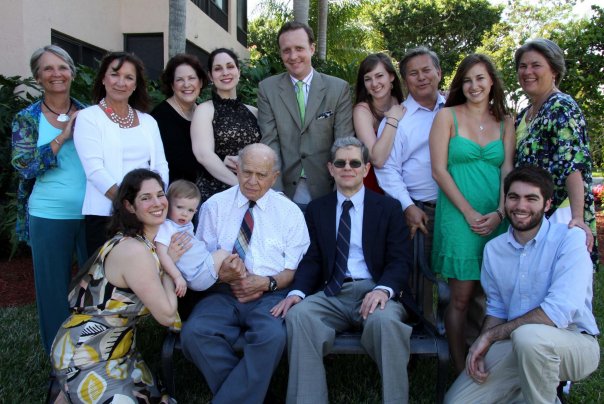

Grandpa Eddie and the Sable clan at his 90th birthday

Birthright to Boycott

Crossposted from Mondoweiss:

A recent post by Adam Horowitz asked what it will take for liberal Zionists to come around and support a boycott. My mind was changed by going to Israel on a Birthright trip and seeing firsthand the effects of the wall and checkpoints. However, I doubt that a full scale boycott of Israel will catch on in the American Jewish community. My recent project, the Boycott Toolkit, enables an open discussion of what exactly a boycott of the occupation should involve, lets users choose their own level of involvement, and lists concrete steps for action.

I was brought up in a religiously conservative but politically liberal Jewish community. While I was aware of and interested in politics, I didn’t consider myself an activist. Like most American Jews, I was aware of the ongoing peace process and lamented the inability of both sides to resolve their differences. A trip to Israel and the West Bank shattered my preconception of the two parties as equal antagonists, and convinced me to become more politically active and outspoken.

I joined a Taglit-Birthright trip in the summer of 2007 after graduating from college. Along with a group of twenty other young American Jews, I went to Israel for the first time and we did all the things that are supposed to connect us to our cultural and religious heritage. We met soldiers, visited Yad Vashem and cried at the Wailing Wall. We climbed Masada at dawn and surveyed the beautiful land that was once promised to our people, and was now ours.

However, while walking through the Old City of Jerusalem, or driving along highways to the Dead Sea, I could see that not all was well in this beautiful land. From a vantage point atop the ancient stone walls, a new concrete wall snakes across the landscape, and settlements stand out starkly on hilltops. Our bus was protected by an armed guard at all times, and he warned us sternly not to venture into Palestinian territory. Danger awaited there, kidnapping or lynching was possible, hatred and discrimination a certainty. He could not have been more wrong.

After the planned activities of the trip were over, we were released from the protection of the tour guides and guards. I returned to Jerusalem with two friends and took a bus to the Bethlehem checkpoint. We approached the monstrous concrete and steel gates with trepidation and entered the maw of the security zone. With our American passports, we were waved through by bored looking young women, really girls no older than I was, but who were surrounded by thick glass and armed with automatic weapons. The Palestinians were subject to more stringent checking, including a biometric scan of the veins in their hands. When I put my hand in the scanner, the guard gave me a withering look, as if it should be clear that I wasn’t subject to the same rules as everyone else in line. This sort of racial profiling may be effective, but it made my stomach churn.

Leaving the checkpoint, we entered a different world. While the Jerusalem side has a proper bus turnaround, in Bethlehem the road dead-ends into the wall and a throng of taxi drivers stand waiting for business. We were approached by a man with a yellow Mercedes, a baseball cap, and large weary eyes. Communicating through his broken English and our worse Arabic we negotiated a tour of the town, learning about its millennia of history and how it had changed since the wall cut it off from Jerusalem. We passed dozens of shuttered businesses and were taken to a dusty souvenir store that opened just for us. I bought ornaments I didn’t need to show my gratitude.

We only spent a few hours in Bethlehem that first time, and were relieved when we crossed the checkpoint back to Jerusalem. We would never see the city the same way again, knowing that an entirely different world lay on the other side of the wall. I have since returned to Israel and the West Bank many times, but crossing checkpoints still gives me the sense that I am crossing a land divided against itself, and that a great injustice is being done in my name.

Returning to the United States, I began graduate study at the MIT Media Lab with the Center for Future Civic Media. Research here is focused on building online tools for organizing real-world communities, and I set out to apply this knowledge to my community of interest: American Jews. I have released three projects that speak to this audience, which grew progressively more action-oriented.

In January 2009 I created VirtualGaza, a space for Gazans to break the information blockade by telling their own stories without a media filter. I spent the following summer meeting with Israeli and Palestinian activists in the West Bank. GroundTruth aggregates geographic information, the path of the wall and the green line, the location of Palestinian neighborhoods and Israeli settlements, the hundreds of checkpoints that disrupt traffic, and displays it in an interface familiar to users of Google Maps. Most of this information is published there for the first time in a reusable and open format. This project provides a local geographic context that is crucial to understanding the reality on the ground.

For my masters thesis, I am building an application to organize collective economic action, inspired by the BDS movement and the concept of smart sanctions. While a wholesale boycott of Israel can engender hostile feelings in even liberal American Jews, the Boycott Toolkit provides detailed information on specific companies and their relationship to the conflict. It asks users to take either positive or negative action by buying or boycotting products, and is open for community contributions. Building upon work by WhoProfits and Gush Shalom, the Boycott Toolkit already includes information on companies that are based in the settlements and industrial zones, vineyards in the occupied Golan Heights, and Palestinian products that support peaceful development. Stores that sell these products are listed and mapped, so consumers can alter their economic behavior to match their politics.

If you see products you recognize, please add stores in your area that sell them, so that we can track our impact in our own local communities. If you have other information about corporate complicity in the occupation, please add it so we can all benefit from your research. I know that these projects by themselves will not resolve the conflict. But if we can change the minds of other Jews like myself, who are vaguely aware of the issues but feel powerless to do anything about it, all our small actions taken together can bring us closer to peace.

Josh Levinger is a graduate student and researcher at the Center for Future Civic Media at MIT, where his work lies at the intersection of technology and politics.

VirtualGaza

I’m back dating this post a bit, but this is the site I worked on all through IAP. And no, Grandpa, I’m not working for Al-Jazeera. I think my implementation is better than theirs.

Now I’m working on cleaning up the code for open release, and finding a host organization to sponsor me on a trip there this summer.

Virtual Gaza is an independent, civic media initiative established by a collective of scholars, media activists and Palestinian residents of Gaza in response to the Israeli assault on the Gaza Strip in December 2008-January 2009.

For years, Israel has been gradually tightening its strangehold on the 1.5 million Palestinians living in the Gaza Strip, sealing its borders and cutting off adequate food, fuel, and medical supplies, bringing the economy and infrastructure to the point of collapse.

Israel has also sought to control how Gaza’s story is told to the outside — from its sophisticated ‘public relations’ campaigns to blocking the entry of foreign journalists.

Virtual Gaza is a space where ordinary Palestinians under siege can describe their experiences in their own words, and where the destruction of the Gaza strip can be documented by those experiencing it directly. The diary entries, photographs, and video material gathered here have been contributed by residents of Gaza. For safety reasons, authors are located in neighborhoods but their precise location is not shown.

Virtual Gaza invites you to help break the information blockade.

virtualgaza.media.mit.edu

Politics, Pageantry and Protest

Instead of enjoying my last two weeks of summer, I watched the political conventions with the help of a bottle of whiskey. To spare you from the same pain, I will summarize the festivities in brief.

The Democrats gathered in Denver to hear from their chosen one, who spoke with a combination of arena rock showmanship and thorough policy detail. Al Gore and John Kerry each displayed a vigor entirely lacking in their respective candidacies, leaving me to wonder where those speeches were when we needed them.

Hillary pretended she’s not still bitter, and tried to get the angry female contingent to unite around the uppity young man who dethroned her. When she rhetorically asked the crowd if they supported her to help the disenfranchised, or because she is a woman, they roared “for you”, confirming everyone’s fears that we truly live in a granny-ocracy.

Bill Clinton reminded us that some Democrats know how to run an economy, even though they decry NAFTA to woo blue collar voters. Jimmy Carter tottered around like a frumpy old man, but was denied a speech because he hates Israel. Joe Biden tried to get a call and response going with the crowd, but stumbled over himself trying to find the punch line. Ted Kennedy showed up just to convince everyone he is still alive. Michelle tried to portray herself as a loving mom, not a Harvard-educated, terrorist-fist-jabbing, honky-hater. She spoke passionately about her and Barack’s family story, all while wearing what is surely the tightest dress ever to grace a potential First Lady’s curves, with the possible exception of Arwen Kucinich notwithstanding.

Obama whistled for the last train to Hopesville, aiming to create change and a better future for the children of tomorrow. Naive hipsters formed lines miles long to get into the arena, only to be horrified by the sight of old white people dancing to Stevie Wonder, Sheryl Crow and Will.i.am for hours. Louis Fernandes SB ’07, who attended the speech, said that “Obama gave me the audacity to hope that hope was enough to change. I found it incredibly moving… to my bowels.”

Across the plains, the Republican convention portrayed John McCain as a maverick, reminded everyone about his noble service when he got shot down in Nam, and put as much distance between himself and George Bush as possible.

Fred Thompson, displaying his classic Southern drawl, tried his hand as a stand up comedian, claiming Sarah Palin is the only vice presidential candidate who can dress a moose. I think he discounted Hannibal Hamlin, the 15th Vice President under Abraham Lincoln and a former Maine farmer, too quickly. And who knows what else Spirow Agnew was capable of.

George Bush phoned it in via satellite for a few minutes, because he was too busy trying to look busy as yet another hurricane barreled toward New Orleans. First Lady Laura took up the charge, reminding us that “our shared American ideals will always transcend political parties and partisanship.” Unless you are a terrorist-coddling-freedom-hater, in which case the gloves come off.

Joe Lieberman, channelling the unholy combination of Chancellor Palpatine and the Joker, tried to sever his last ties with the Democratic party, wishing he was the vice presidential nominee all the while. Luckily for everyone, he already had his chance and he is now forever removed from the political gene pool.

Sarah Palin tried to show that she is a smart pick, not just because she is a vagina-American and Miss Alaska 1984 runner up, but because her executive experience in Wasilla is greater than that of anyone else on the ticket in either party. She also nominated her husband Todd for “first dude”, citing his qualification as a championship snowmobile racer. I think they just won over the NASCAR dad voting block en masse.

Rudy Giuliani bared his snaggle tooth and decried the cosmopolitan, effete nature of the Democrats, which is perfectly in character for a man who has been in drag on national television being felt up by Donald Trump. And then the big hero, John McCain came out, and sounded the clarion call for change. No one seemed to question the fact that the audience was entirely made up of the very bigwigs and fatcats that he pledged to throw out. They cheered all the same, because he’s the only chance they have to keep the party going.

While the confetti fluttered inside and blazered bigwigs gulped champagne, a different kind of conversation took place across the river in Minneapolis. Groups of Ronvoys rolled to Ronstock to disgorge their load of Paultards for three days of peace, love and liberty. They were serenaded by such political luminaries as Tucker Carlson, Grover Norquist and Jesse Ventura. And still, no one takes them seriously.

Also outside the mainstream political coverage, various groups of activists protested both conventions. Fox correspondent Griff Jenkins waded bravely into the fray in Denver, only to be surrounded by a group of masked Zapatistas. His interview prompt was “do you believe in freedom?” He didn’t get very far before being drowned out by chants of “fuck Fox News.”

At both convention cities, members of Iraq Veterans Against the War conducted simulated exercises from their deployment experience. Holding their hands up as weapon surrogates, they patrolled urban streets in squad formation. Wearing full desert camouflage, they captured and hooded “Iraqi civilians” to the horror of passersby. The purpose of this street theater was to demonstrate the reality of the current occupation to the American public, delegates and elected officials. It’s not giant puppets or flaming effigies, but at least it was entertaining.

In the Twin Cities, massive preventive arrest sweeps were conducted against such dangerous radicals as members of Food Not Bombs, a bus full of environmentalists, and the National Lawyers Guild. As Glenn Greenwald at Salon.com points out, this is exactly the same behavior that the mainstream media was decrying as China prepared for the Olympics. But when it happens in the United States the Washington Post hails it as law enforcement at work. Seemingly, those freedoms we all care so much about aren’t really respected when you want to do something so dangerous as hold an unauthorized street march.

After the balloons are cleared from the aisles, the tear gas canisters from the streets, and the bloggers all go back to their basements, the campaigns can begin their real work of putting obnoxious ads on television. Next week, everyone can go back to watching America’s Next Top Slut, but for two glorious weeks, the eyes of the world were fixed on our favorite whores in suits, and I watched it all so you didn’t have to.


Published in The Tech September 9, 2008

Convention Coverage

Well, Barack gave an inspiring speech about hope, and the future and blah blah blah. I wish I was there for this.


Nothing like a group of angry masked liberals shouting obscenities at Fox News. Do you not believe in freedom? Although, with the preemptive arrests at the RNC, it looks like that was the place to be this year. I do love a good riot peaceful demonstration. Time to get out my gas mask and my black bandana.